
METiS TechBio (7666.HK), a global leader in AI-powered drug delivery innovation, today officially launched its AiProtein platform and antibody design agent AARON (AI Antibody Rational Optimization Network).
AiProtein adopts METiS TechBio’s proprietary "dry lab + wet lab + intelligent agent" innovation paradigm and is a design platform focused on macromolecules such as proteins and antibodies. As the fourth core solution powered by METiS TechBio’s AI nanodelivery platform NanoForge, AiProtein works together with AiLNP (AI Nanodelivery System Design Platform), AiRNA (AI mRNA Sequence Design Platform), and AiTEM (AI Small-Molecule Formulation Design Platform) to complete METiS TechBio’s “rocket + satellite” end-to-end R&D closed loop spanning protein design, mRNA sequence design, and LNP design.
Dr. Chris Lai, Chairman and CEO of METiS TechBio, stated: “Over the past few years, METiS TechBio has continued to decode the language of human delivery and build “nano-rockets” capable of precisely reaching different organs and cells. With the launch of the AiProtein platform and the AARON antibody design agent, we are now extending our AI capabilities further to the “satellites” themselves, creating an AI-driven, end-to-end R&D workflow spanning protein design, mRNA sequence design, and LNP delivery.
We believe large-molecule drug discovery and development is entering a new paradigm that brings together dry-lab experimentation, wet-lab validation, and intelligent agents. AARON is more than an antibody design tool; it is an AI scientist partner that can coordinate multiple models and accelerate antibody generation and engineering optimization. Going forward, METiS TechBio will continue to drive AI-powered innovation in large-molecule discovery and delivery, helping more molecules once considered difficult to drug move closer to the clinic and, ultimately, to patients.”
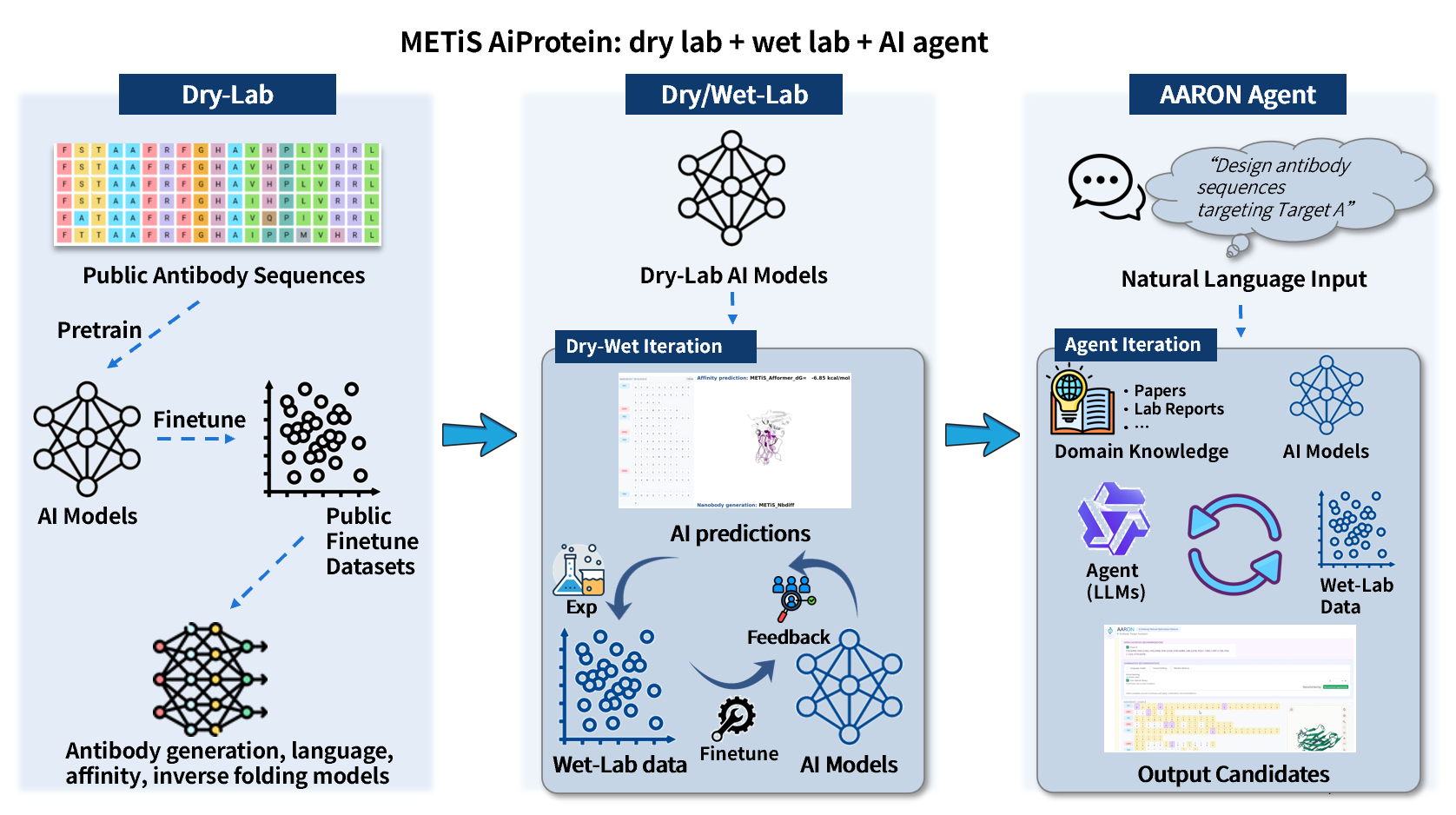 Figure 1: Schematic illustration of METiS AiProtein’s new “dry lab + wet lab + intelligent agent” paradigm
After more than one year of development, the AiProtein platform has completed the in-house development of a series of models and algorithms, including de novo generation models, language/prediction models, affinity prediction models, developability prediction models, and active learning-driven dry-wet iterative algorithms. Among these, METiS TechBio has developed METiS NbDiff, a diffusion algorithm-based antibody de novo generation model that enables directed generation based on user-defined conditions such as antigens and epitopes. In addition, the AiProtein platform is equipped with METiS TechBio’s proprietary protein/antibody language models for proteins and various antibody formats. These models incorporate major improvements to the traditional BERT architecture and support the prediction of more than ten commonly used protein and antibody properties. For key properties, the models have achieved Spearman correlation coefficients above 0.8.
In antibody engineering, the AiProtein platform supports AI-driven affinity maturation of antibody hits obtained through animal immunization or screening of self-built libraries. METiS TechBio has also specifically developed METiS ProteinIFGT, an inverse folding model that substantially improves upon the industry gold-standard ProteinMPNN model. The model innovatively introduces a graph Transformer architecture into protein inverse folding, achieving varying degrees of improvement across multiple metrics compared with the original model. Building on this foundation, METiS TechBio further developed METiS NbIFGT, a model designed specifically for nanobodies. Together with the aforementioned METiS NbBERT, it serves as a “dual safeguard,” enabling antibody mutation prediction from two different dimensions and creating a new paradigm for antibody engineering.
In addition, affinity prediction for mutations is a critical step in antibody engineering. METiS TechBio has developed METiS Afformer, a model that innovatively introduces a graph Transformer architecture into antibody affinity prediction. By learning the antibody-antigen binding region at the atomic level, the model has achieved R² and Spearman correlation coefficients approaching or exceeding 0.8 across multiple datasets, greatly improving the success rate of antibody engineering. In terms of antibody developability, METiS TechBio has integrated several open-source models and, based on the aforementioned language models, developed its own solubility prediction model and a yield prediction model based on METiS TechBio’s proprietary data. Together, these models form the developability module and complete the dry-lab workflow.
Video 1: The METiS AiProtein platform enables antibody generation and antibody engineering through proprietary models
METiS TechBio’s NanoForge platform applies active learning to dry-wet experimental iteration. Building on this experience, METiS TechBio has further applied this concept to the AiProtein platform, creating a new dry-wet iterative paradigm that integrates language models, inverse folding models, affinity prediction models, and active learning. In several internal projects, this approach has enabled the target activity of antibody engineering to be achieved within two rounds, significantly improving both success rate and efficiency.
As the “central processor” for wet-lab databases, dry-lab algorithms, and dry-wet iteration, METiS TechBio’s next-generation antibody design agent AARON can orchestrate various AI models developed by METiS TechBio. Through an intuitive, visualized, and intelligent interface, AARON enables scientists to conduct human-machine interaction and complete tasks such as antibody generation, property prediction, mutation prediction, affinity prediction, and developability prediction. It can also carry out dry-wet iteration through active learning algorithms, using AI to decode the language of antibodies and opening a new paradigm for antibody R&D.
Video 2: Example workflow of the METiS AARON intelligent agent
Looking ahead, METiS TechBio will continue to develop and optimize the AiProtein platform, with a focus on AI-driven development of TCE-specific antibodies, antibody conformation design, and antibodies for active LNP targeting.