
METiS TechBio (7666.HK), a global leader in AI-powered drug delivery innovation, today announced that Dr. Andong Liu, Vice President and Head of Technology Platform of the Company, has received the 2026 Distinguished Investigator Award from the Gene Delivery & Gene Editing Focus Group of the Controlled Release Society (CRS). METiS TechBio is the only Chinese company to receive an award at this year’s CRS Annual Meeting.
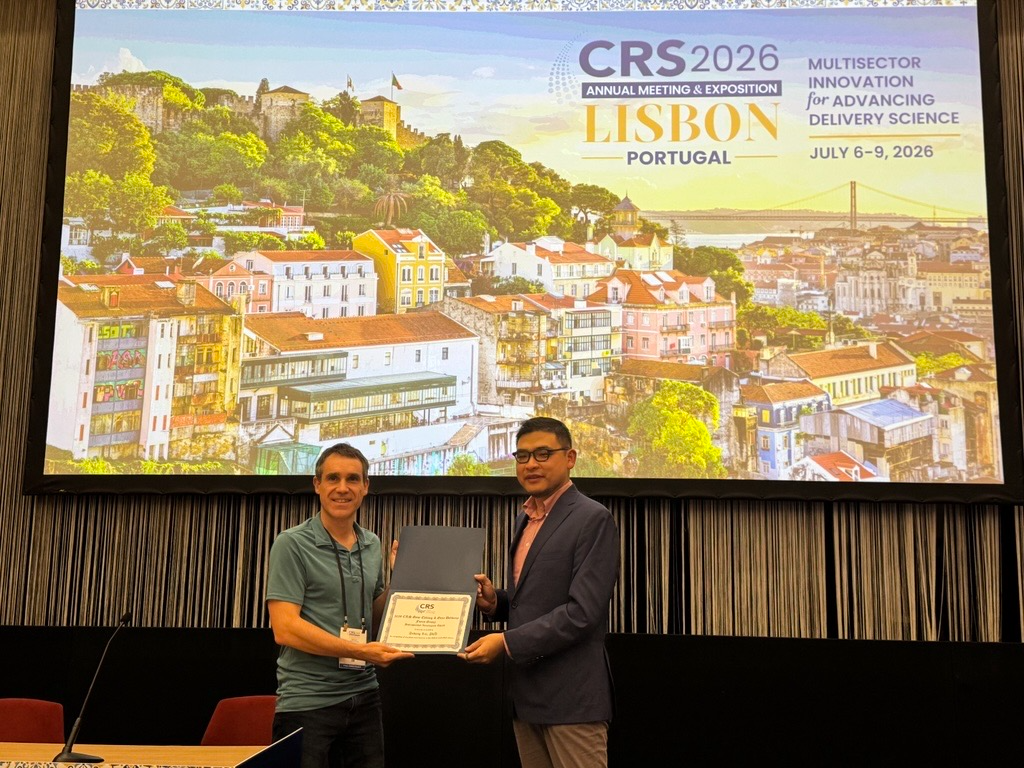
Left: Álvaro Somoza (Ph.D.), Research Professor, Institute for Advanced Studies in Nanoscience (IMDEA Nanociencia)
Right: Dr. Andong Liu
Dr. Liu received the award in recognition of an abstract demonstrating that METiS TechBio, leveraging its AI-driven nanodelivery platform NanoForge, achieved near-complete (~100%) cardiomyocyte transfection and highly efficient gene editing through systemically administered heart-selective lipid nanoparticles (LNPs), described as “a remarkable result in one of the hardest delivery targets in the field” .Gene delivery and gene editing are among the most active research areas at this year’s Annual Meeting. From all abstracts submitted, the selection committee chose the most groundbreaking results for the award, which recognizes outstanding investigators who achieve original breakthroughs in their fields and continue to advance the industry.
Dr. Liu also delivered a Late Breaking oral presentation at the 2026 CRS Annual Meeting, titled “Systemic Heart-Selective Lipid Nanoparticles for High-Efficiency In Vivo Delivery and Cardiomyocyte Gene Editing.” In addition, Dr. Liu was invited to deliver an awardee presentation during the Gene Delivery & Gene Editing Focus Group award session, titled “Targeted Delivery as the Pivot: Elevating Established Therapeutics and Unlocking Extra-Hepatic Frontiers via AI-Informed Design.”
Dr. Chris Lai, Co-founder, Chairman and CEO of METiS TechBio, said, “AI will accelerate drug development from the target era into the delivery era, and AI will also empower China to generate more original R&D paradigms. We are confident that NanoForge will become critical infrastructure for AI for Science in life sciences R&D.”
At this year’s Annual Meeting, Dr. Liu presented breakthrough advances enabled by METiS TechBio’s NanoForge platform in cardiomyocyte-targeted in vivo gene editing. The study showed that the Company’s proprietary cardiomyocyte-targeted tLNPs (CM-tLNPs) enable highly efficient and precise delivery of Cre mRNA and CRISPR/Cas9 editing systems to cardiomyocytes. CM-tLNPs achieved near-complete (~100%) cardiomyocyte transfection, while delivery of the CRISPR-Cas9 system produced approximately 50% genome editing in cardiomyocytes. At the same time, extremely low signals were observed in non-target tissues including the liver, spleen and skeletal muscle, demonstrating excellent organ selectivity. This marks an important advance in overcoming the long-standing industry bottleneck of conventional LNPs’ natural liver tropism, enabled by novel delivery materials designed by NanoForge. It also further demonstrates NanoForge’s capability as an AI-powered drug delivery infrastructure to consistently generate original research outcomes.
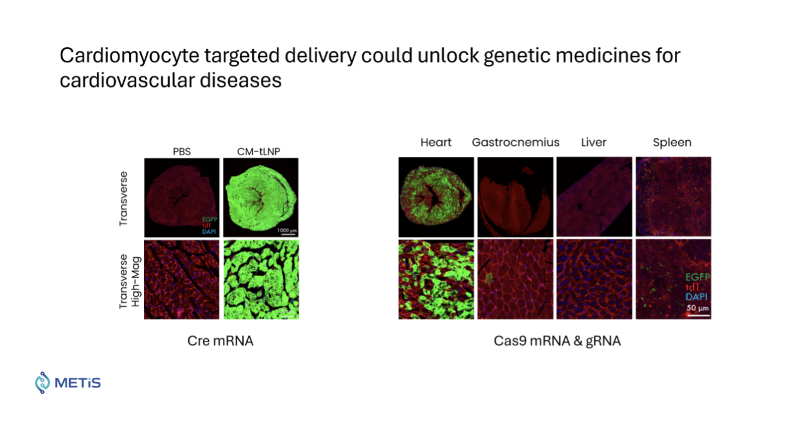
The heart has long been regarded as one of the most challenging organs for extrahepatic LNP delivery. Delivery systems must not only overcome the liver’s natural sequestration effect, but also cross vascular barriers and efficiently enter cardiomyocytes, which are widely recognized in the industry as one of the most difficult cell types to transfect. Achieving near-complete cardiomyocyte transfection means that genetic medicines may, for the first time, be able to enter the vast majority of target cardiomyocytes efficiently and precisely through systemic administration. This could significantly improve therapeutic efficacy while reducing off-target risks, opening up new therapeutic possibilities for major diseases such as inherited cardiomyopathies, heart failure and post-myocardial infarction repair. It also indicates that AI-powered organ-targeted delivery technology is accelerating from proof of concept toward clinical value realization.
NanoForge is the world’s first AI-powered nanodelivery platform independently developed by METiS TechBio. It has built what is currently the world’s largest ionizable lipid library at the ten-million scale, independently developed what is currently the world’s only lipid de novo generation algorithm and lipid language model, established the world’s first end-to-end lipid and lipid nanoparticle (LNP) screening platform, and pioneered the world’s first AI + multiscale simulation platform for small-molecule formulations. Based on NanoForge, the Company has developed four major technology solutions: AiTEM, AiLNP, AiRNA and AiProtein. The AiLNP platform currently enables deep analysis powered by artificial intelligence and molecular dynamics simulations. It can predict more than 20 lipid property parameters and design and optimize the key components and ratios of LNPs, enabling the construction of customized, high-performance delivery systems.
About the Controlled Release Society
Founded in 1978, the Controlled Release Society (CRS) is one of the most authoritative and influential international academic organizations in the fields of drug delivery, controlled-release formulations, nanomedicine and nucleic acid delivery. Its members come from more than 50 countries and regions, covering interdisciplinary fields including pharmaceutics, biomaterials, biomedical engineering, nucleic acid therapeutics and translational medicine. The CRS Annual Meeting brings together leading universities, research institutions and international pharmaceutical companies from around the world each year, and is widely recognized as an important bellwether for the development of global drug delivery technologies.